Explore
Read the park
PEEP.R 2K, the Resource Finder, map information, Buggies and traversal networks make the environment legible and reachable.
Feeds → resources, objectives, routes and encounter decisions
Grounded 2 is a network of survival systems: information leads to resources, resources build infrastructure, progression opens routes, Buggies reshape traversal and logistics, and encounters feed back into the world. This reference follows those connections in depth on the current live branch.
Reviewed state: live version 0.5.1 · selected first-party system sources rechecked 25 September 2026.
Grounded 2 works because exploration, information, harvesting, building, progression, Buggies, encounters and world access repeatedly feed back into one another. The systems below are most useful when read as loops rather than as a checklist.
PEEP.R 2K, the Resource Finder, map information, Buggies and traversal networks make the environment legible and reachable.
Harvesting, Buggy gathering, hauling and Omni-Tool capability determine what can be collected efficiently and brought home.
BUILD.M, material sets, utilities, Coziness and underwater construction turn resources into persistent footholds.
Brainpower, equipment, mutations, Omni-Tool branches, region gates and Buggy progression expand what the player can do.
Weapons, armour, mutation choices, archetype guidance, Buggies and environmental constraints create changing combat problems.
Custom Game and Playgrounds expose settings, logic tools and authored encounters outside the standard survival loop.
PEEP.R 2K and Resource Finder reduce the information cost of exploration; Brainpower and tool progression then convert discovery into recipes and practical capability.
Find → identify → unlock → craft → reach more of the park [P05] [P12]Buggies harvest, haul, fight and traverse; bases hatch/support them and later provide progression infrastructure. The systems reinforce rather than replace one another.
Hatch/summon → gather/haul → build/support → upgrade → tackle harder routes [P03] [P10]By 0.5, some hostile pressure reacts to player actions. Stranger heat can escalate into O.R.C. retaliation, while MIX.R activity can alter that pressure.
Player action → attention → warning → retaliation → counter-pressure [P30]The Abyss makes this clearest: Optical Discs, Diving Suit upgrades, Swimming 2.0, underwater building and specialised harvesting combine into a region-specific progression stack.
Prepare → dive → unlock → build → go deeper [P12] [P30]Scope: this page explains the current mechanical architecture. It deliberately avoids weapon stat tables, meta builds, exact resource coordinates and patch-by-patch changelogs.
Grounded 2 uses archetypes as a language for playstyles, while the actual build is assembled from gear, weapon behaviour, active/passive mutations, Buggy support and the environment being tackled.
Chris Parker described these as familiar concepts for communicating combinations rather than permanent classes. Players can change role by changing equipment and mutations.
The live game distinguishes active and passive mutation types. Later updates add specific player and Buggy mutations without replacing the broader archetype model.
| Combat layer | What it controls | Current examples |
|---|---|---|
| Weapon interaction | Reach, timing, blocking and damage delivery. | Beat the Heat added bow blocking; underwater combat adds dedicated ranged/explosive options. [P10] [P30] |
| Equipment | Protection, specialised survival and build direction. | Region-specific equipment matters most clearly underwater, where the Diving Suit is progression-critical. [P12] |
| Mutations | Build reinforcement and action-linked passive/active effects. | Player, passive and Buggy mutation layers coexist. [P10] [P30] |
| Buggy support | Companion damage, control, tanking, mobility and utility. | Red Ant general-purpose support, Orb Weaver control, Ladybug tank/utility and later specialised Buggies. [P03] [P06] [P10] |
| Encounter rules | Environmental and systemic constraints around the fight. | O.R.C. waves, O.G.R.R. variants, underwater combat and boss gates create different preparation problems. [P10] [P30] |
Updates have added blocking with bows, reworked poison-gas interactions, underwater lock-on and aquatic weapons. Patch 0.5.0.5 reduced over-aggressive creature behaviour and softened the O.G.R.R. Toe Biter Leviathan encounter after player feedback; 0.5.1 is now the current live build.
Boss encounters can still function as progression gates, but the current Tier 4 Omni-Axe recipe must not be inferred from the 0.5.0.5 state. Patch 0.5.1 removed Infused Ooze and changed the recipe. Because the official note does not enumerate the complete replacement ingredients, whether the O.G.R.R. Toe Biter Leviathan remains a current requirement is not established by the captured first-party evidence.
The launch design explicitly lets players fight while riding a Buggy and also dismount so the Buggy acts as a companion. That makes mount choice part of the combat architecture rather than merely a travel preference.
On Mild and Medium, the launch deep dive says a downed Buggy that is not revived returns to its nest and recuperates for a few in-game hours. On the hardest setting, Buggy death can be permanent. Difficulty therefore changes the persistence risk attached to a companion, not just enemy damage.
Buggy AI also changed in 0.5.1: increased perception is intended to make Buggies join fights more easily, alongside fixes for inventory handling, nest destruction, Toe Biter Sweep behaviour and summoning restrictions. [P51]
The Buggy layer spans acquisition, naming and nesting, mounted actions, companion combat, inventory, traversal, harvesting, progression, mutations, tier upgrades and creator-mode activities. Different species change how you move through and work in the park rather than simply increasing travel speed.
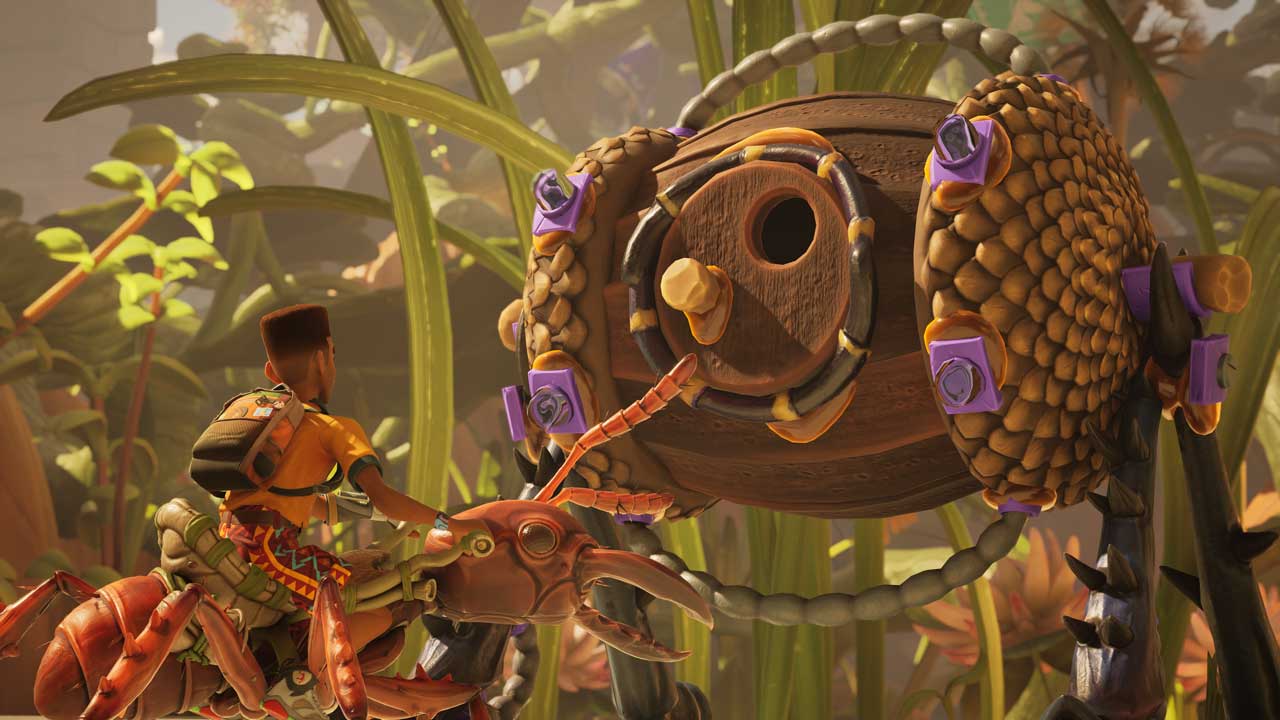
The launch all-rounder demonstrates how broad the Buggy concept is. First-party developer material describes fighting, cutting grass, gathering items in bulk, carrying inventory, placing/building blueprints and operating as a companion after dismounting.
Designed as a more combat-focused partner, with strong damage and web/control behaviour. Launch material also gives it traversal value on webbed routes; later Beat the Heat changes replaced its no-fall-damage property with a gliding ability.
Toxic Tangle expands the roster into a more defensive support role. Its official ability set includes a healing purr, a powerful ram and a water blast that can disrupt airborne pests or wash away Tang buildup.
Beat the Heat adds a later ant-family option with its own species identity, including Tang Spit and sour-linked utility. Developer commentary explicitly describes Buggy progression as a way to keep same-family Buggies viable at comparable tiers, so Black Soldier Ant should not be read as a simple replacement ladder for Red Soldier Ant.
Into the Abyss extends Buggies into the aquatic loop. The Toe Biter moves on land and in water, linking traversal, combat and underwater exploration rather than forcing the player to abandon the Buggy system at the shoreline.
Buggies are owned companions: players can pet and name them, keep more than one and give them nests. When a Buggy is downed it can be revived. If it is not revived, Mild and Medium return it to its nest for a few in-game hours of recovery; the hardest difficulty can make Buggy death permanent.
| Layer | Function | Why it matters |
|---|---|---|
| Moldy Milk Molars | Player-level progression resource for Buggies. | Lets the Buggy system scale instead of resetting with each new species. [P10] |
| Stat/capability upgrades | Health, stamina, healing effectiveness, revive state, inventory and related capability. | Keeps early Buggies relevant in later content. [P10] |
| Mutations | Cross-Buggy, family-specific and species-specific effects. | Turns species identity into build identity rather than raw stat differences. [P30] |
| Buffin' Barrel | Raises a Buggy to a higher tier and improves what it can handle/gather. | Explicitly solves the problem of beloved early Buggies becoming obsolete. [P10] [P35] |
System relationship: Buggies now intersect with harvesting, inventory/Hotpouch, combat, traversal, base utilities, progression, mutations and Playgrounds racing. Taken together, they function as a core survival system rather than a vehicle feature.
The survival layer is intentionally simple at the needs level — food, water, shelter and supplies — but the surrounding systems have become increasingly sophisticated.
Hunger and thirst remain baseline survival concerns, so exploration has an operating cost. Cooking and consumables sit underneath every longer expedition rather than existing as a separate minigame.
Need → forage/hunt → cook/store → travel farther [P33]PEEP.R 2K and Resource Finder let players mark and track resources, while the Chopping List keeps required materials visible during collection.
Recipe/material need → track → highlight nearby resource → gather [P05]Mounted gathering, Buggy inventories and hauling capability reduce the repeated return-to-base friction that dominated the original on-foot loop.
Harvest more → carry more → build farther from base [P03] [P33]Storage, crafting/cooking stations, Hatchery/Buggy utilities and specialised workstations make the base the place where gathered resources become new capabilities.
Materials → recipes/structures/upgrades → new routes and encounters [P10] [P30]The Resource Analyzer feeds the Brainpower progression loop. Into the Abyss explicitly adds Brainpower-exclusive recipe rewards, so finding and analysing new materials can expand what the player can craft rather than merely identify an item.
Discover material → analyse → raise Brainpower → unlock recipes [P30]Into the Abyss replaces the older Crafting-menu presentation with a Recipe Menu that lets players check ingredients and required tools while away from a workstation. That turns recipe knowledge into an exploration aid as well as a base function.
Find recipe → inspect requirements anywhere → track/gather → craft [P30]It does not list every material, recipe, drop table or best farming route. Those are database/guide jobs. The systems question is how information, carrying capacity, tools, bases and progression change the cost of acquiring and using resources.
Molar upgrades gained another live progression layer. Patch 0.5.1 adds upgrades for Mega Milk Molars, Milk Molars and Moldy Milk Molars, and expands the available upgrade tiers for Milk and Moldy Milk Molars. [P51]
Grounded 2 progression is best understood as parallel tracks: recipes/Brainpower, tools, equipment, mutations, Buggies, traversal, bases and region-specific gates.

| Track | What advances | How it changes play |
|---|---|---|
| Brainpower | Recipe/progression unlock state. | Turns discoveries/resources into a wider craftable capability set. [P12] [P30] |
| Milk Molars | Regular Milk Molars upgrade the teen and are separate from Moldy Milk Molars used for Buggies. | Adds a distinct exploration-led player progression track without conflating player and companion upgrades. [P03] [P10] |
| Omni-Tool | Harvesting branches such as Omni-Axe and Omni-Clipper. | Changes which resource tiers/environmental objects can be harvested. [P12] [P15] |
| Equipment | Armour/weapons and environment-specific gear. | Build specialisation plus survival access, clearest with Diving Suit progression. [P12] |
| Mutations | Player active/passive effects and action-driven specialisation. | Changes how an existing loadout behaves without locking a class. [P10] [P30] |
| Buggy progression | Shared Buggy stats, mutations and tiers. | Keeps companions viable and widens their support/combat/gathering role. [P10] |
| Discovery / key items | Optical Discs and Critter CAPZ reward exploration in different ways. | Optical Discs unlock the Diving Suit progression path; Critter CAPZ are a separate hidden-collectible reward layer. [P12] [P30] |
| Base/Coziness | Utility infrastructure and decoration-linked perks. | Rewards investment in a persistent home rather than treating a base as storage only. [P05] |
| Traversal/network | PTS access, ziplines/ZIP.R, swimming capability. | Reduces travel friction and opens routes that are otherwise inefficient or inaccessible. [P12] [P30] |
PEEP.R 2K is part of the wrist-device layer rather than a standalone binocular. Current functionality includes first/third-person use, zoom, a scrollable Chopping List, dynamic compass, backpack/trail-marker controls and Resource Finder tracking/highlighting.
The Resource Analyzer is part of the recipe-progression loop rather than a disposable scan station. Into the Abyss explicitly adds recipes that unlock only through Brainpower progression at the Analyzer, so resource discovery continues to matter after the opening hours.
Developer material confirms hidden regular Milk Molars remain part of the park, while Beat the Heat describes Moldy Milk Molars as the Buggy equivalent of regular molars for the teen. The reviewed first-party set does not fully re-document every current regular-Molar upgrade allocation, so this page does not manufacture a stat table.
Into the Abyss requires a one-time Raw Science cost to add PTS units to the expanded park-wide transit network. First-party patch and Issue Tracker material also confirms the Science Shop remains part of the live progression economy, although its complete current catalogue and costs are not reproduced here.
Into the Abyss adds hidden Critter CAPZ across Brookhollow Park as a completionist/exploration layer. They sit alongside — but are mechanically distinct from — Milk Molars and Optical Discs, which have different progression jobs.
Current live branches include the Omni-Axe and Omni-Clipper. Tier IV progression exists in specific live paths, but later roadmap items still extend Omni-Tool progression; “Tier IV exists” and “all Tier IV tool progression is finished” are not the same claim.
Optical Discs unlock Diving Suit recipes; the suit extends depth/endurance; the Omni-Clipper harvests underwater resources; Swimming 2.0 and Burst then make deeper movement practical. The biome is therefore gated by a stack of systems rather than one key.
The 0.5.0.5 path used the O.G.R.R. Toe Biter Leviathan as a gate after an unintended shortcut was corrected. Patch 0.5.1 changed the recipe, so the exact current Leviathan requirement is not established by the captured first-party evidence.
The building loop now combines placement tooling, decorative progression, storage/crafting, Buggy support and underwater habitation. It is no longer just “put walls around a bed”.
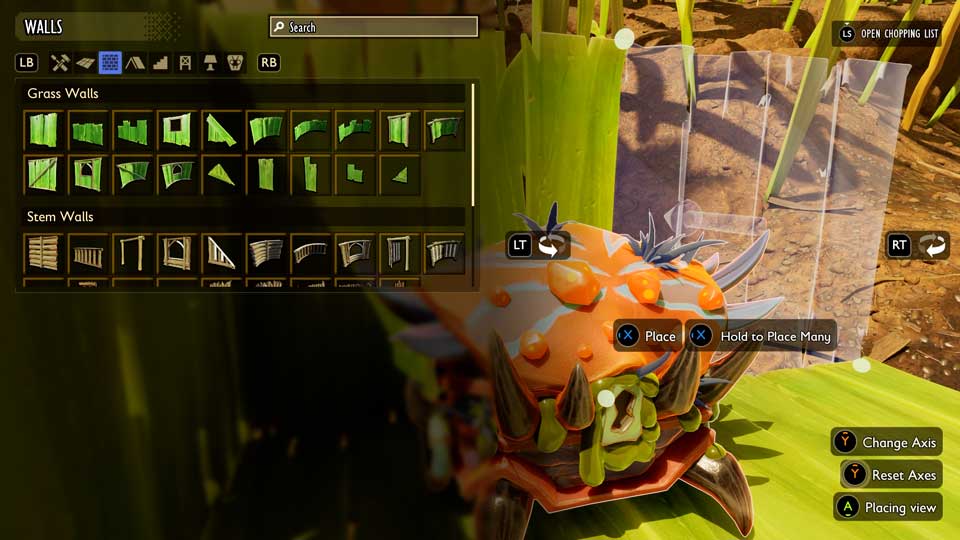
0.2 introduced the BUILD.M/grid-led workflow and continued building-placement improvements. Later updates expand materials and pieces without replacing that underlying planning model.
Decorating a base unlocks perks, so aesthetic investment has mechanical value. The current system also includes a dynamic lo-fi music layer that changes with Coziness, giving the home state both functional and atmospheric feedback.
The wider Buggy system includes Hatchery/nest concepts, the Buggy Buff Hut and Buffin' Barrel progression. A base therefore becomes the service layer for companions as well as the player.
0.5 adds/uses specialised stations such as the Forbidden Workbench for Stranger-related crafting and the Glitter Bar for cosmetic SCA.B 2K/Omni-Tool customisation. These are system-specific utilities, not ordinary crafting-table aliases.
Bubble Floors create breathable spaces, Bubble Diffusers provide an air-source system, and the wider underwater building set allows the base to become a staging/research outpost inside the Pond loop rather than only on the shoreline.
The current roadmap still lists Base Moving as a future plan. This page therefore treats the current building loop as persistent construction plus utilities — not a relocatable-base system.
Buggies, fixed Ominent transit, player-built ziplines and environment-specific movement solve different travel problems. They sit on top of ordinary on-foot exploration rather than replacing it.
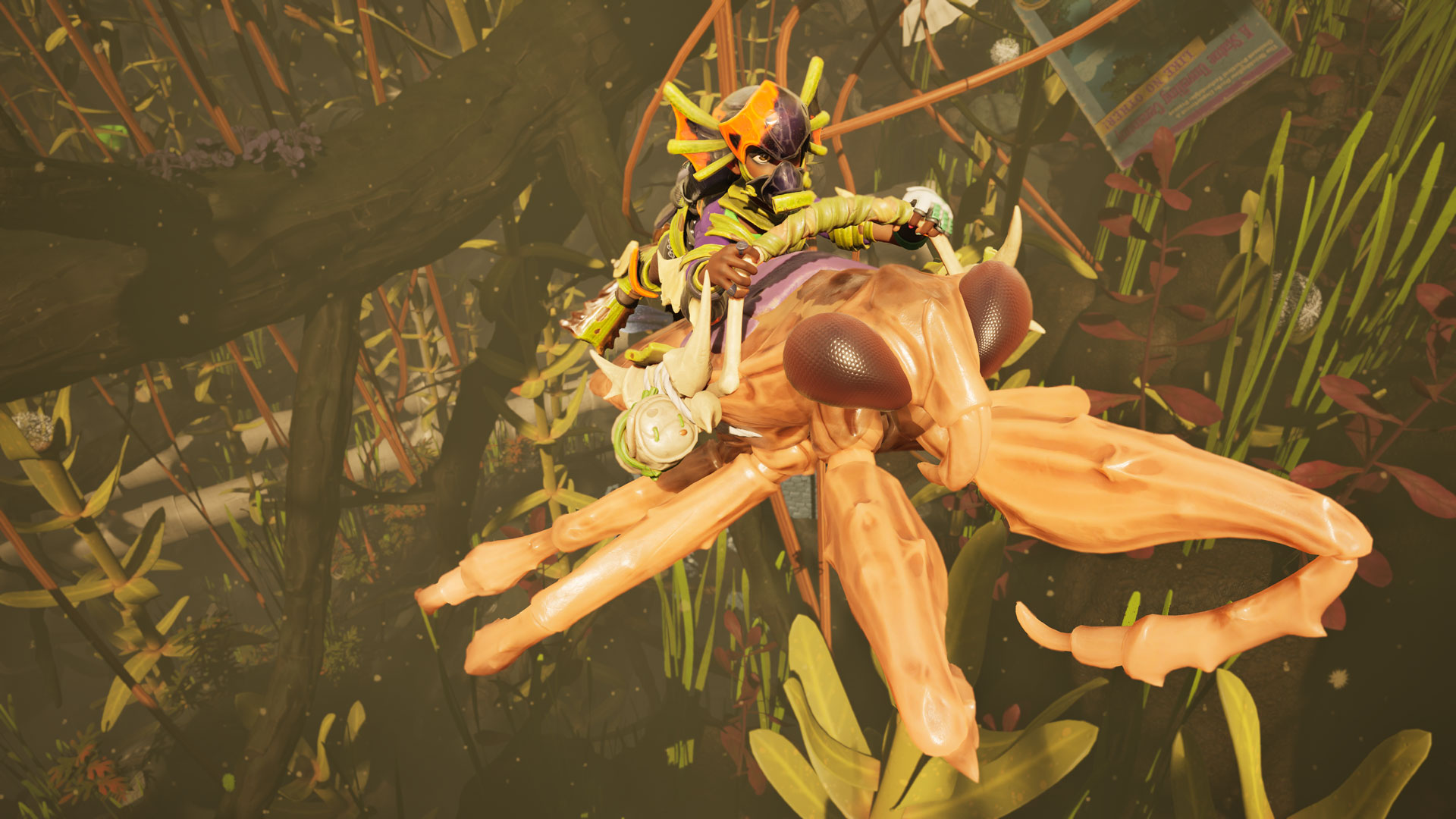
| Network | Ownership | Mechanical job | System connections |
|---|---|---|---|
| Buggies | Player companions | Mobile traversal plus gathering, hauling and combat. | Progression, inventory, harvesting and species-specific access. [P03] [P10] [P12] |
| Pneumatic Transit System | Fixed Ominent infrastructure | Fast travel between activated park facilities/outposts. | 0.5 expands network connectivity after activation/cost. [P30] |
| Ziplines + ZIP.R | Player-authored network | Lets players turn their own base/world layout into repeatable travel routes. | ZIP.R supports bidirectional travel, reducing route asymmetry. [P12] [P30] |
| Swimming 2.0 | Environment-specific movement | Agile underwater travel and combat, including directional Burst. | Diving Suit, Bubble infrastructure, aquatic weapons and Toe Biter Buggy. [P12] [P30] |
Launch developer material gives Red Soldier Ant and Orb Weaver Buggies different world-access advantages, while Toe Biter later connects the Buggy system to water. Route choice can therefore depend on companion capability, not only player equipment.
PEEP.R 2K, compass/map information and Resource Finder do not move the player directly, but they reduce the navigation cost of finding objectives and resources. Grounded 2's exploration layer is partly an information problem.
Swimming 2.0 improves movement, but deeper exploration still depends on Diving Suit progression and other aquatic capability. Mobility and survival access are deliberately separate layers.
PTS is a fixed network; ziplines are player-designed. Keeping both means Grounded 2 supports convenient long-distance infrastructure without eliminating the value of constructing a personal transport network.
Into the Abyss turns the Stranger/O.R.C. layer into a repeatable systemic pressure loop while keeping O.G.R.R., Tang and MIX.R as distinct systems with their own roles.
MIX.Rs are repeatable defence/wave activities in the current game. Repairing an overloaded MIX.R lets the challenge be run again, and 0.5 gives MIX.R completion a second job inside the Stranger-attention economy by reducing heat. Repaired MIX.Rs can also cause O.R.C. creatures to return to the zone.
The Beacon converts stored O.R.C. parts into a summonable wave encounter. It is distinct from the Stranger-linked transmission devices that appear in the heat system.
O.G.R.R. enhanced enemies can change familiar encounters, but they are a separate research/enemy-enhancement concept from O.R.C. controlled creatures and Stranger heat. Treating them as one system would erase important mechanical and narrative differences.
Toxic Tangle establishes Tang across soil, water and creatures. It interacts with survival/combat and even Buggy utility, but it is not merely an O.G.R.R. or O.R.C. status effect.
Grounded 2 supports solo play and online co-op, while Microsoft-account infrastructure links crossplay, Shared Worlds and community Playgrounds.
| Capability | Current position | Important boundary |
|---|---|---|
| Player count | Up to four players total in online co-op. | Local/offline multiplayer and co-op are not supported. [P31] [P21] |
| Crossplay | Xbox, PC and PlayStation can play together. | Documented cross-platform functions require a linked Microsoft/Xbox account and relevant platform online service. [P20] |
| Shared Worlds | Supported as the shared/persistent co-op world mechanism. | Current Grounded 2 support confirms Shared Worlds and their cross-platform account layer. The familiar “friends can continue without the owner” behaviour comes from the original Shared Worlds definition, so it is useful inherited context rather than a newly re-documented Grounded 2 contract. [P20] [P32] |
| Cross-progression | Game Director Chris Parker says Grounded 2 supports cross-progression across PC, Xbox and PlayStation. | Obsidian’s older support FAQ explicitly documents PC↔Xbox saving, while the newer PS5 support article does not spell out every save/world-transfer edge case. Treat the developer confirmation as real, but do not invent undocumented transfer behaviour. [P37] [P21] [P20] |
| Custom Game 1.0 | Live settings package for altering game rules. | The “1.0” belongs to this feature label; it is not Grounded 2 full release. [P30] |
Shared Worlds versus Playgrounds: both use the cross-platform account layer, but they solve different problems. Shared Worlds are the survival-world sharing mechanism; Playgrounds distributes authored custom experiences. They should not be collapsed into “dedicated servers”.
It is more than unrestricted building: creators can connect logic, spawn creatures, author encounter waves, control paths/zones, build with dedicated sets and publish experiences for other players. [P36]
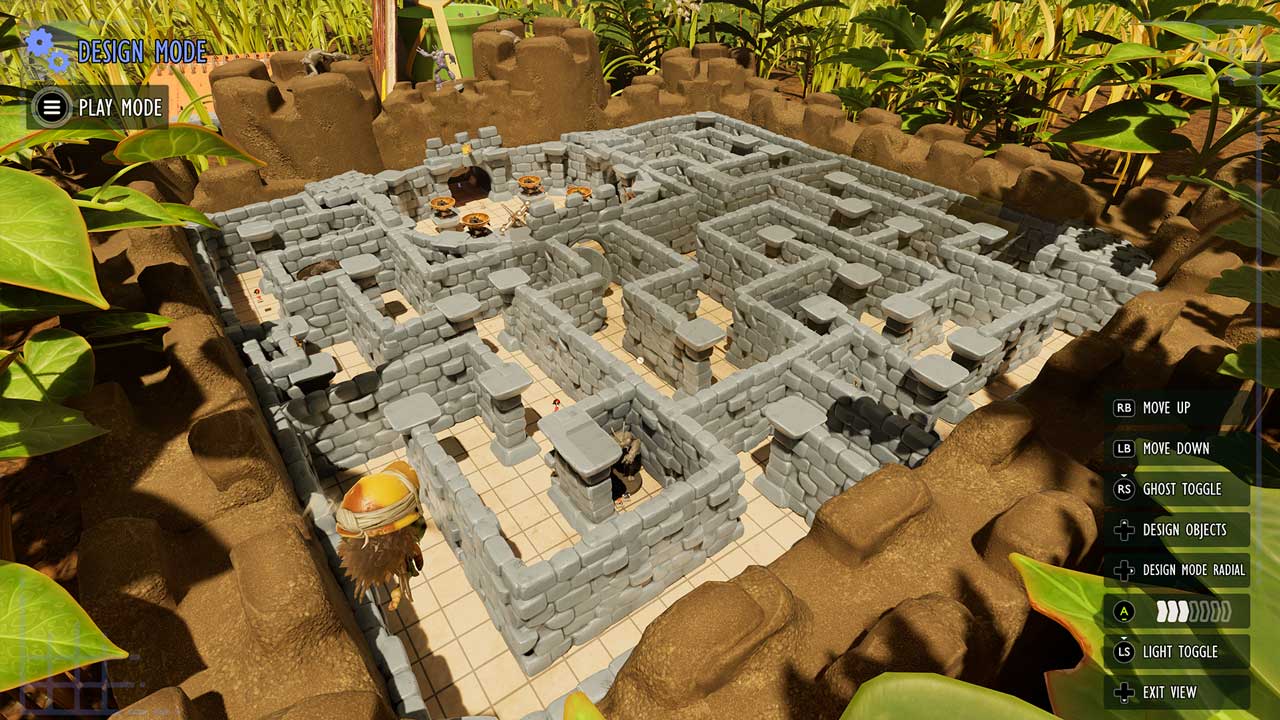
Trigger Volumes can activate linked tools; Random Chance can branch outcomes; Creature Spawners can then turn those results into reactive combat or surprise encounters.
0.5 adds dedicated MIX.R Creature Spawner and Wave Manager gizmos so creators can configure participants, starting positions and wave progression instead of relying on the survival-mode MIX.R rules.
Pathing Waypoints and Creature Zones make authored movement/behaviour possible. Object grouping, primitive shapes, laboratory building pieces and expanded props widen the kinds of spaces that can be built.
The creator tool supports precise building and access to difficult construction positions. It is a Playgrounds tool — not the biological Gnat creature.
Racing supports one to four players, point-to-point or lap layouts, checkpoints and track-surface mechanics. It demonstrates that Playgrounds can produce rule-driven multiplayer modes rather than only sandbox scenes.
Obsidian's Playgrounds release explicitly supports downloading, playing and voting on community creations. The creator loop therefore ends in distribution and discovery, not only local experimentation.
Assets, creatures and tools available in Playgrounds do not automatically prove that the same content or behaviour exists in Survival Mode. Creator-mode availability is not a shortcut to current-game confirmation.
Early Access makes temporal discipline essential. A roadmap label is not part of the current mechanical architecture until it actually ships.
Updates & Change History owns the full release ledger. This condensed mechanical history shows how systems have moved from isolated capabilities toward connected loops.
Traversal, gathering, building support, mounted combat and companion behaviour become part of the baseline game rather than late-game convenience.
BUILD.M changes building workflow; Coziness and PEEP.R 2K add progression/information layers around bases and exploration.
Ladybug adds a tank/utility Buggy role while Tang creates an environmental/status interaction across creatures and terrain.
Moldy Milk Molars, Buggy mutations and Buffin' Barrel make Buggies scalable; bow blocking and O.G.R.R. enemies broaden combat.
Buggy Racing demonstrates that Playgrounds can host authored rule-driven multiplayer modes.
Swimming 2.0, Diving Suit progression, underwater building, Toe Biter traversal and aquatic combat make the Pond a distinct loop rather than another biome.
Stranger heat and O.R.C. waves make repeated player actions feed back into future encounters.
Custom MIX.R tooling, pathing/zones and new build sets expose more of the game's own encounter logic to creators.
Molar upgrades expand, Infused Ooze is removed, the Tier 4 Omni-Axe recipe changes and a broad Buggy/progression/fix pass becomes the current live state. [P51]
Balance, performance, controls and individual mechanics remain subject to change. The 0.5.0.5 aggression pass was explicitly described as an initial step, and 0.5.1 demonstrates that the 0.5 branch is still receiving progression and system revisions. [P15]
Current-state claims are anchored primarily to first-party announcements, patch notes and support documentation, with a direct developer interview used where current support pages leave an important boundary under-documented. Older sources are used only where their specific system statement remains compatible with the current branch.
Current high-level gameplay, archetypes and Buggies framing.
Open source ↗Archetypes as build guidance; Buggy companion roles, naming/nesting, difficulty loss rules, hidden Milk Molars and route-gating abilities.
Open source ↗BUILD.M and broader system improvements.
Open source ↗Coziness, PEEP.R 2K, resource tracking and engine/performance changes.
Open source ↗Ladybug Buggy and expanded building/system content.
Open source ↗Creator-mode logic tools, custom encounters and community sharing.
Open source ↗Buggy progression, Moldy Milk Molars and Buffin' Barrel.
Open source ↗Detailed Buggy progression, Moldy Milk Molars, mutations, Buffin' Barrel, bow blocking and current utility buildings.
Open source ↗Playgrounds racing mode and Steam Deck/crossplay changes.
Open source ↗Swimming 2.0, underwater progression/building and Toe Biter Buggy.
Open source ↗Current Molar, Buggy and Omni-Axe progression changes.
Open source ↗Historical combat/balance and earlier Tier 4 Omni-Axe progression fix.
Open source ↗Cross-platform multiplayer, Shared Worlds and Playgrounds account requirements.
Open source ↗Online co-op, local/offline boundary and Xbox/PC cross-progression documentation.
Open source ↗Detailed 0.5 system state: Swimming 2.0, Recipe Menu, Brainpower-exclusive rewards, Raw Science-backed PTS expansion, repeatable MIX.Rs, Stranger heat/waves, Custom Game 1.0 and Playgrounds expansion.
Open source ↗Supports the four-player total co-op framing.
Open source ↗Defines Shared Worlds as worlds invited friends can continue using while the owner is offline.
Open source ↗Survival needs, early Buggy acquisition and hauling/gathering role.
Open source ↗Developer explanation of Buggy progression as a long-term core team system.
Open source ↗Grassbox/Brookhollow maps, Handy Gnat and creator inventory scope.
Open source ↗Grounded 2 Game Director Chris Parker states full PC/Xbox/PlayStation cross-play and cross-progression; exact save-transfer workflows are not exhaustively documented in current support pages.
Open source ↗Current gameplay/input defects and current-system references, including Milk Molar scanner and Science Shop/Mixology entries.
Open source ↗Reviewed through 21 September 2026. Future roadmap mechanics appear only where needed to mark a current/not-current boundary.